Auckland tree pruning
Tree Trimming & Pruning Auckland
The tree can stay. It just needs to be smaller, lighter, higher off the roof or rid of its dead wood. Free on-site quote, a written scope naming exactly which cuts, and a full clean-up.
- Crown reduction, lifting & thinning
- Branches off roofs and gutters
- Green waste chipped and removed
The service
Trim, prune or remove?
Most of the tree problems people ring about — too much shade, branches over the roof, a limb hanging over the drive, dead wood, a canopy crowding the house — can be fixed by pruning. It costs a fraction of a removal and the tree stays. Removal is the honest answer when the tree is failing structurally, regrows so fast you would be cutting it forever, or is simply in the wrong place.
In everyday Auckland use, “tree trimming” and “tree pruning” describe the same job, and an arborist will answer to either. What actually matters is which cuts are made and where. If you want to understand the options before anyone turns up, we have written up the difference between pruning and trimming, and the main types of cut. Palms are the exception to all of this: they grow from a single bud at the top and are cleaned rather than pruned, which we cover under palm trimming.
We price the pruning first when it will genuinely solve the problem. When it won't — a tree that will be back on the roof in eighteen months, or one with a defect no amount of cutting will fix — we will say so, and tell you whether tree removal is the better money.
Tree trimming and pruning in Auckland — the essentials
- Typical cost: $200–$600 for a light trim on a small tree, $500–$1,500 for a medium tree, $1,200–$4,000+ for large or complex work over buildings. Typical Auckland ranges incl. GST, not quotes.
- Typical duration: an hour or two for a small tree; half a day to a full day for a large crown reduction with the clean-up.
- Consent: not needed for most garden trees. Notable trees and trees in a Significant Ecological Area can be trimmed without consent only within strict limits (no branch over 50 mm, no more than 10% of live growth a year).
- Power lines: nobody but a network-approved arborist works within 4 metres of a line.
- Included: the agreed cuts, chipping, cartage and clean-up. Keeping the wood chip for your garden costs nothing.
What we prune
Types of tree pruning we do
Pruning is not one job but a set of specific cuts, each one solving a particular problem: clearance, height, light, safety or structure. A good quote names which type of pruning is being done and how much, so you know what the tree will look like afterwards. These are the six we are asked for most across Auckland.
Crown lifting
Removing the lowest branches to raise the canopy over a lawn, path, driveway or roof line, or to give vehicles and people headroom. It lets light in under the tree without touching the top. Common on pōhutukawa, liquidambar and oaks that have spread over a drive. The clearance is agreed in metres before anyone climbs.
Crown reduction
Bringing height or spread down by cutting branches back to suitable side branches, the growth points, so the tree keeps its natural shape at a smaller size. This is how height comes off properly. It is not topping, and a reduction done well is hard to spot a year later.
Crown thinning
Taking out a share of the inner, crossing and crowded branches evenly through the crown so light and wind pass through, while the outline stays the same. Done lightly it reduces wind load. Overdone, it strips the inside of the limbs and leaves weight at the tips, which weakens them.
Deadwooding
Removing dead, dying and broken branches: the most common safety prune and the one that can be done at any time of year. On a scheduled notable tree, the Auckland Unitary Plan permits dead wood removal without consent when a qualified arborist does it, so ask whoever quotes for proof of that qualification.
Clearance pruning
Branches cut back off the roof, gutters, spouting, chimney, fence, shed or the neighbour’s side, usually with a set gap so the job lasts. For overhanging branches, see trimming a neighbour’s tree back to the boundary. Power lines are the exception, covered further down this page.
Formative and storm-damage pruning
Shaping young trees early, one leader and no tight forks, so they never need heavy cuts later. After a storm, cleaning up torn and hanging limbs so the wounds are clean. If a whole tree is down or hung up, that is emergency tree work rather than a pruning visit.
Topping means cutting the top or main limbs back to stubs at whatever height someone has picked. It produces a flush of weakly attached shoots, leaves large wounds that rot, and usually makes the tree more dangerous and more expensive to manage within a few years. Auckland Council states that it does not practise or condone topping on public trees. If height has to come down, it is a crown reduction to proper growth points, or an honest conversation about removal.
Pricing
What tree trimming costs in Auckland
A light trim on a small tree usually costs $200–$600, a medium tree of 6–15 m $500–$1,500, and large or complex work over buildings $1,200–$4,000 or more. Two things move a pruning price more than height does: how much of the crown is coming off, and how hard it is to reach and lower safely.
| Job | Typical cost | What it usually covers |
|---|---|---|
| Light trim, small tree (under ~6 m) | $200 – $600 | A few branches off a roof, fence or path; ground or ladder access |
| Medium tree (6–15 m) | $500 – $1,500 | Crown lift, thin, deadwood or clearance; climbing |
| Large or complex (15 m+) | $1,200 – $4,000+ | Crown reduction, rigging over buildings, platform access |
| Several trees / whole property | Quoted | Priced as one project; cheaper per tree |
Typical Auckland ranges incl. GST, with chipping and clean-up included. They are planning figures, not quotes: a medium tree over a glasshouse can cost more than a large one in an open paddock. For prices by type of cut and how to read a quote, see the full tree trimming and pruning cost guide.
Method
How a pruning job works
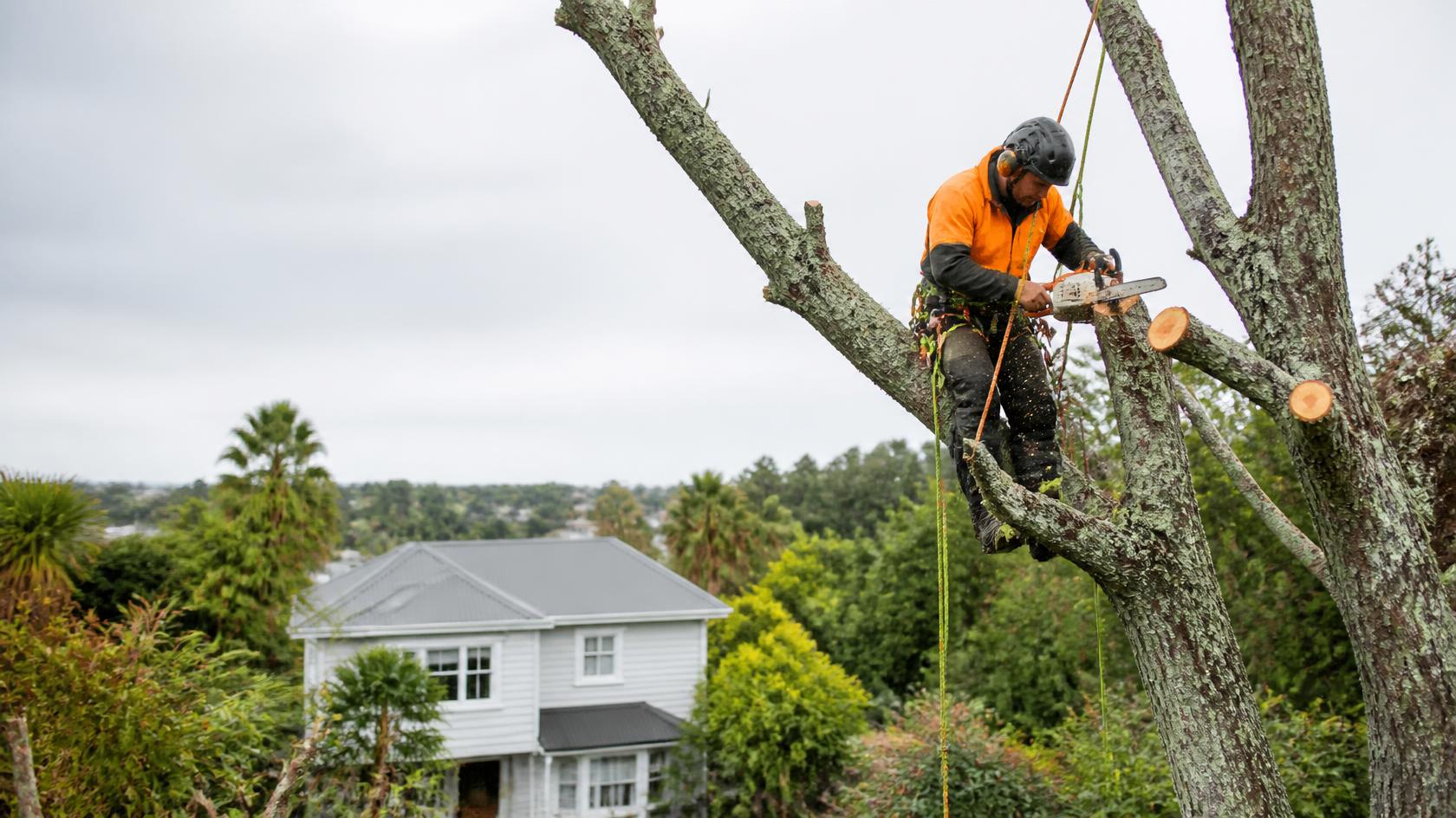
A pruning job is planned on the ground before anyone climbs. We look at the tree’s health and defects, agree the result you want, check whether the tree is protected, then set up so nothing drops on the roof or the garden. The cuts follow the agreed scope rather than whatever comes off easily, and the job finishes with the site chipped, raked and swept.
Look and agree the cuts
We walk round the tree, check its health and any defects, and agree the objective: a clearance distance, a height, more light. That goes into the written quote, down to which limbs are coming off.
Check protection status
GeoMaps for notable-tree and Significant Ecological Area overlays, and the tree’s position near the coast or a stream. If limits apply, the work either stays inside them or the consent route is raised before anything is booked.
Set up
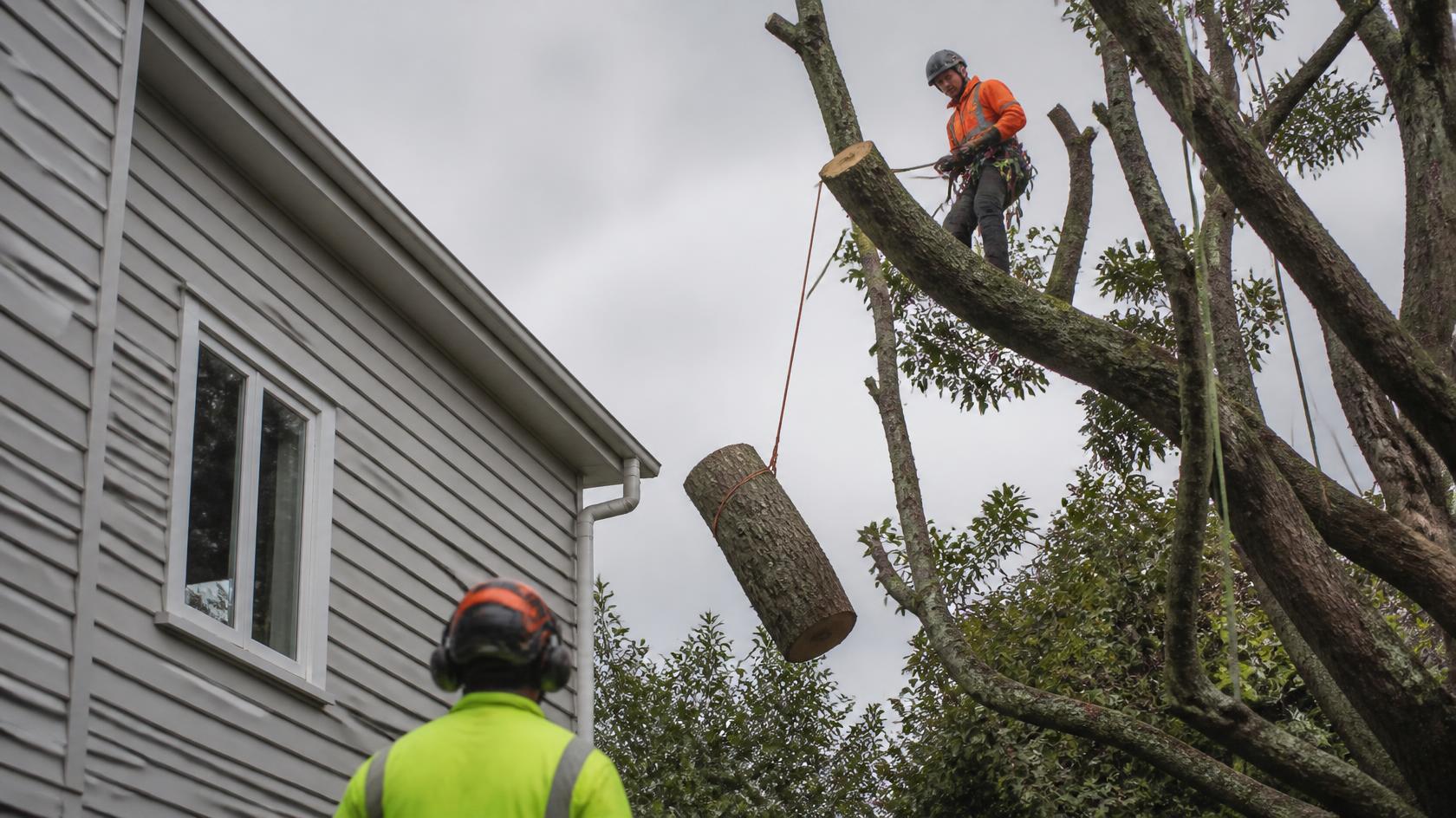
A marked drop zone, ground protection over lawns and paving, rigging points chosen over roofs and glasshouses, and cars moved out of the way.
Climb and cut
Each cut is made just outside the branch collar, with no stubs left behind. Heavy limbs are lowered on ropes rather than dropped, and the crown is shaped to the agreed target, not to whatever is quickest.
Chip, clear and walk through
Brush is chipped, wood cut up or carted, the area raked and swept. Then we walk the result with you before we leave.
Before you book
Can you prune a protected tree in Auckland?
Often yes, within limits. The Auckland Unitary Plan lets you trim a scheduled notable tree, or a tree in a Significant Ecological Area, without resource consent as long as no branch thicker than 50 mm is cut, no more than 10% of the live growth comes off in a calendar year, the work follows good arboricultural practice and the tree keeps its natural shape. Beyond that, you need consent.
Dead wood on a notable tree is treated differently: the plan permits its removal when the work is done by a qualified arborist, which it defines as someone holding at least a level 4 NZQA certificate in arboriculture or an equivalent qualification. Ask whoever quotes for evidence of it.
Coastal and stream-side trees are the other trap. In the plan’s definitions, “vegetation alteration” includes crown pruning, so pruning a native tree over 3 m tall within 20 m of the coast, near a coastal cliff top or within 10 m of an urban stream can need consent. Pōhutukawa are the usual case; read our pōhutukawa pruning and removal rules before booking one.
Removing a tree is a separate question with its own rules, set out in our Auckland council consent guide. This is general information; confirm your own tree with Auckland Council.
Where to check
- Auckland Council GeoMaps — notable trees and overlays for your address
- Unitary Plan D13 Notable Trees Overlay (PDF) — the trimming standards
- Tree work rules for your property — Auckland Council
- Working on or around protected trees — Auckland Council
Safety first
Trees near power lines
Keeping trees on your property clear of the network lines is the owner’s legal responsibility, but nobody except a qualified, network-approved utility arborist may trim within 4 metres of a line. Vector calls that the professional-only zone. If your tree reaches into it, contact Vector first. If you have had a cut or trim notice and Vector hasn’t trimmed that tree before, the first cut is at Vector’s cost.
We prune the parts of a tree that are more than 4 m from the line, and can finish the rest once the line side has been dealt with. Vector publishes its list of approved utility arborists on managing trees around lines, and our guide covers who is responsible for trees near power lines.
Tree too big for the section?
Free on-site look anywhere in Auckland. We will tell you which cuts actually solve the problem, put the scope in writing, and leave the site clean.
Where we work
Tree trimming across Auckland
We prune trees right across the region, from the North Shore to South Auckland. What changes from one area to the next is less the price than the trees themselves and the rules that apply to them: coastal pōhutukawa in one suburb, bush overlays in another, big old exotics on tight sections in a third.
North Shore. Coastal pōhutukawa and reserve-edge trees hang over a lot of small sections here, so the coastal pruning rules come up more often than elsewhere. A typical job in Takapuna is lifting and clearing a canopy off a house without changing the tree’s shape; our pōhutukawa pruning and care guide explains the timing and how much to take.
West Auckland. Bush sections, Significant Ecological Area overlays and kauri dieback hygiene shape the work around Titirangi, where trimming has to stay inside the SEA limits. Down on the flats it is fast wattle and gum regrowth that keeps coming back.
Central and the isthmus. Large exotics — oaks, liquidambars and planes — on tight villa sections, pruned off roofs and out of the neighbours’ light. In Remuera a crown reduction is often the way to keep a big tree that suits the street.
South and East Auckland. Bigger sections, shelterbelts and boundary gums, plus coastal pōhutukawa along the Howick and Bucklands Beach shoreline. Around Howick the first step is usually checking whether the tree is scheduled.
Related services
You might also need
Tree Removal
When pruning won’t fix it: a tree that is failing, outgrowing the section, or would need cutting every year.
Tree removalLarge & Dangerous Tree Removal
Defects, decay, or a limb that has already cracked over something you can’t afford to lose.
Complex removalsStump Grinding
If part of the job is taking a tree out altogether, the stump can be ground on the same visit.
Stump grindingQuestions
Tree trimming and pruning FAQs
How much does tree pruning cost in Auckland?
A light trim on a small tree under about 6 m usually costs $200–$600. A medium tree of 6–15 m is typically $500–$1,500, and large or complex pruning over buildings runs $1,200–$4,000 or more. The price rises with how much of the crown comes off, how awkward the access is, and whether limbs have to be rigged down over a roof. These are typical Auckland ranges including GST and clean-up, not quotes.
Is it cheaper to trim a tree or cut it down?
A single pruning visit is almost always cheaper than removing the same tree. The sums change when a tree needs heavy pruning every year or two: a fast regrower can overtake the one-off cost of removal within a few years. Wattle and some gums are the classic examples. A healthy tree with one problem limb is nearly always worth pruning; one you will be fighting forever usually isn’t.
How often should trees be pruned?
Most established garden trees need attention every three to five years, younger trees more often while their structure is being set, and dead wood whenever it appears. Fast growers near roofs may need a visit every year or two. For comparison, Auckland Council says a routine prune of its street trees happens on average every five years. Regular light pruning is usually cheaper and kinder to the tree than an occasional heavy cut.
Can I trim a council tree on my berm?
No. Street and berm trees belong to Auckland Council, so don’t prune them yourself or pay anyone else to. Lodge a maintenance request with the council instead. Council prunes public trees for safety, health and obstructions such as footpaths, signs and lines, but not to open up views, reduce shade or cut down on leaf and fruit drop, even when the branches hang over your section.
Do I need consent to prune a tree on my property?
For most garden trees, no. A scheduled notable tree or a tree in a Significant Ecological Area can be trimmed without consent only within the limits: branches no thicker than 50 mm, no more than 10% of live growth a year, natural form kept. Native trees near the coast or an urban stream can need consent even for pruning. Check GeoMaps for your address, or ask us to check when we quote.
Will pruning make my tree safer in a storm?
Usually, if it is the right kind of pruning. Taking out dead wood, shortening over-extended limbs and lightly thinning a dense crown all reduce wind load and the chance of a branch failing. Topping and heavy lopping do the opposite over time, because the regrowth is weakly attached. A tree with cracks, decay or root problems may need a proper assessment rather than a trim; see signs a tree is dangerous.
Do you prune fruit trees?
We reduce the height, remove dead wood and clear large, overgrown fruit trees away from roofs, fences and lines — old plums, avocados and feijoas that have grown into proper trees. Annual pruning for a better crop, such as shaping a young apple or lemon, is a job for a gardener or orchardist, and we will tell you so rather than charge you for it.