Palm tree removal & trimming
Palm Tree Removal Auckland
Palms of every size taken out or tidied up, spiny Phoenix palms included. We take them down in sections from the top, or lower them whole where there is room, grind out the stump, and cart every frond and trunk round away. Free quote, price in writing.
- Phoenix palms handled safely
- Fronds, trunk and stump removed
- From $400 per palm
The service
Palm tree removal in Auckland: the short answer
Most palms come down in a few hours. The crown is cut away first, frond by frond, then the trunk is taken down in sections, or felled whole where there is clear ground to drop it. The stump is ground out or the root ball dug up, and the fronds and trunk leave site with us. Most removals cost $400–$3,500+ incl. GST depending on size, species and access: see palm removal prices.
A palm is a different job from a broadleaf tree. There are no limbs to rig off, but the trunk is a dense, fibrous column that is usually heavier than people expect, and the crown can carry dozens of fronds several metres long. The Canary Island date palm (Phoenix canariensis), the big Phoenix palm in so many older Auckland gardens, has leaves 4–6 m long with sharp spines on their stalks.
So each removal is planned around the site: climbing and sectional dismantling, an elevating work platform, or a crane where access needs one, quoted for that job. Before anything is cut we identify the species, because three of the common ones are pest plants with rules about what happens next, and we check whether the palm is a scheduled notable tree, because some are.
Know your palm
Which palm do you have?
Five kinds of palm make up most of the palm work in Auckland gardens: Phoenix, queen, bangalow, the fan palms and the native nīkau. The species changes how hard the removal is, what it costs and which rules apply, so it helps to know which one you have before you ring anyone. If you are unsure, a photo of the trunk and one frond is usually enough for us to tell.
Phoenix palm
Phoenix canariensis, the Canary Island date palm. A heavy, stocky trunk patterned with diamond-shaped leaf scars and a dense crown of long fronds with sharp spines on the stalks. The hardest common palm to remove safely. It is a pest plant in Auckland, so it can’t be planted or sold, yet some individual Phoenix palms are scheduled notable trees.
Queen palm
Syagrus romanzoffiana. A slender single trunk up to about 15 m, soft feathery fronds, and heavy crops of sticky orange fruit that drop on paths and lawns. Dead fronds hang on until someone cuts them off. Usually the most straightforward palm to remove. As far as we can find it is not listed as a pest plant in Auckland; confirm with Auckland Council if it matters to you.
Bangalow palm
Archontophoenix cunninghamiana, often sold as king palm. A grey trunk of even width marked with leaf-scar rings, a green crownshaft below the fronds, and hanging purple flowers that ripen into scarlet fruit. It is a pest plant in Auckland: birds carry the seed into bush, where it competes with nīkau. It can’t be planted, sold or given away.
Fan palms
Washingtonia grow very tall, past 20 m, and if left untrimmed keep a thick skirt of dead fronds down the trunk. The Chinese fan or windmill palm (Trachycarpus fortunei) stays under about 12 m. Both carry sharp teeth along their leaf stalks. The Chinese fan palm is an Auckland pest plant; Washingtonia is not listed, as far as we can find.
Nīkau
Rhopalostylis sapida, the only palm native to mainland New Zealand. Slow-growing, with a swollen green crownshaft and fronds up to 3 m long. Usually worth keeping, so we often suggest a tidy-up rather than removal. A nīkau is not automatically protected, but some are scheduled notable trees and others grow inside protected overlays, so it gets checked first.
Pest status from Auckland Council’s Regional Pest Management Plan pages; notable-tree status from Auckland Unitary Plan Schedule 10.
Phoenix palms
Why Phoenix palms need a different approach
The spines are the main reason. The frond stalks carry stiff, sharp spines that can go straight through work gloves and snap off in skin, and Auckland Council warns they can cause serious injury. Add fronds 4–6 m long that fall unpredictably once cut, a dense trunk that makes every section heavy, and a crown full of seed, and a Phoenix becomes a job to plan rather than one to hack at.
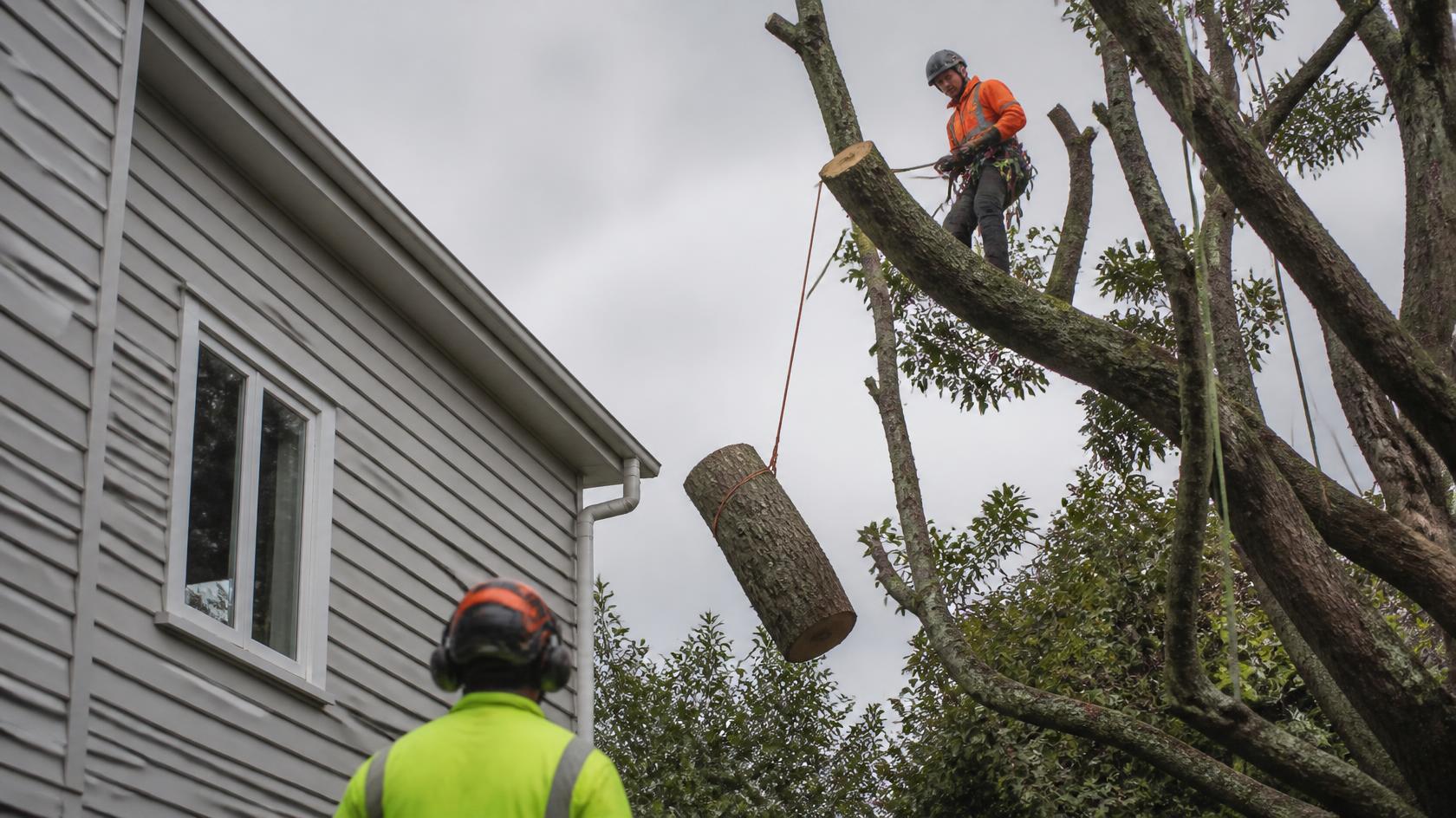
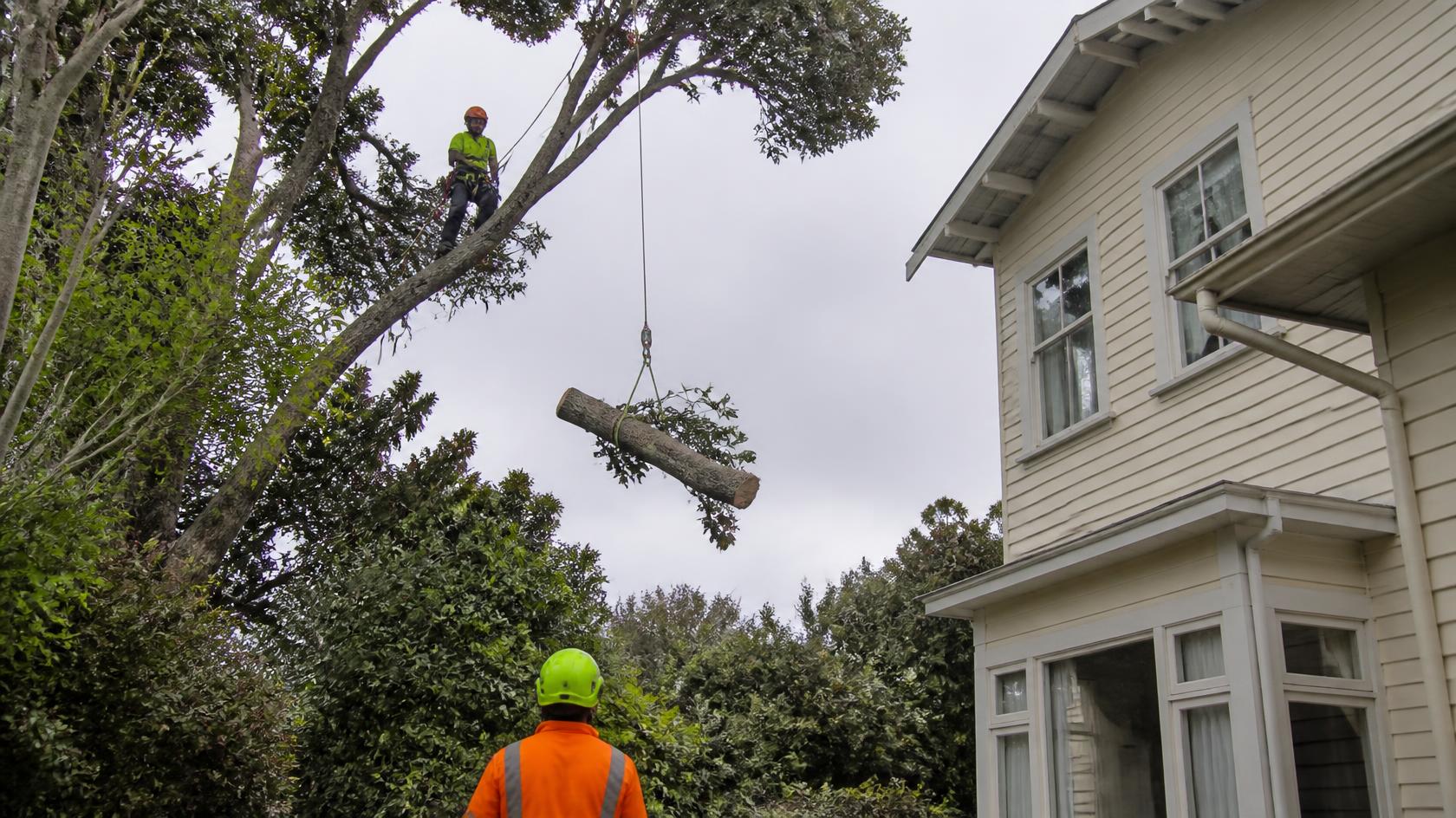
On a typical removal the fronds are cut from the top and lowered or dropped into a cleared, marked drop zone, with the spiny ends kept away from anyone below. Seed heads come off early so the fruit doesn’t scatter across the garden. The trunk then comes down in sections on a rope, or is felled whole where there is clear ground. Over a roof or a pool, or with no room to work, a platform or crane can be the safer route, priced for that site.
Broken spine tips end up in lawns and garden beds, so the clean-up includes a rake-through of the drop zone, not just a sweep of the paths.
Wear thick gloves, long sleeves and eye protection, and keep children and pets away from cut fronds lying on the ground. If a spine breaks off under the skin and won’t come out, or a puncture turns red, warm or swollen, see a doctor: Healthify notes that thorns and plant spines are among the splinters most likely to become infected.
Before anyone cuts
Rules: Phoenix palms are a pest plant, and some are protected
In Auckland, Phoenix, bangalow and Chinese fan palms are pest plants under the Regional Pest Management Plan: you can’t plant, breed, sell or give them away. You don’t have to remove a palm you already have unless it was planted in breach of those rules and an authorised person directs you to. Separately, some palms are scheduled notable trees, and a notable tree can’t be removed without resource consent.
What that means for your palm
- Pest status doesn’t remove protection. The Auckland Unitary Plan’s notable tree schedule lists dozens of individual Phoenix palms and groups, in Herne Bay, Ponsonby, Epsom, Onehunga, Ōtāhuhu, Papakura and across the North Shore, along with nīkau, Washingtonia and a few queen palms. Most Phoenix palms don’t need consent to remove. Some do, so check before anyone cuts.
- How to check. Search your address on Auckland Council GeoMaps for the notable tree overlay, or ask us: we look before we price any palm. On the Hauraki Gulf islands, notable trees sit in a separate district plan schedule.
- Nīkau and other natives. Not automatically protected. Protection comes from the schedule or from an overlay such as a Significant Ecological Area, or the coastal and stream-edge rules.
- Waiheke and the other Gulf islands. Phoenix and Chinese fan palms are also listed under the Hauraki Gulf Controlled Area Notice, so check with the council before taking palm material or seed off an island.
- What we won’t do. Move a Phoenix, bangalow or Chinese fan palm to another property, or sell or give away the plants or their seed. The pest rules don’t allow it, and we don’t relocate palms.
This is general information, not legal advice. For the wider picture, read when you need council consent to remove a tree, and for the pest rules in full see Auckland Council’s Phoenix palm pest page.
Keeping the palm
Palm tree trimming: how much and how often
Palm trimming means cutting off dead and hanging fronds, flower and seed stalks and, where the species suits it, loose old frond bases on the trunk. Most palms need it about once a year. Phoenix palms are best done before their fruit ripens in summer, so the seed doesn’t drop and spread. Trimming is quoted per palm, because a 3 m nīkau and a 15 m Phoenix are very different jobs.
Leave the green fronds. University of Florida extension advice is to remove brown fronds and leave the green ones, and never to cut above an imaginary line running from 9 o’clock to 3 o’clock across the crown. That line is the limit, not the goal. Live fronds feed the palm and shelter its growing bud, so the stripped “pineapple” or “feather duster” look weakens it.
When to trim. The palm itself doesn’t mind much what month it is cut, so timing is mostly about the fruit. Phoenix palms flower in October and November and fruit over summer, which makes late spring to early summer the usual window for taking the seed heads off before they ripen.
Can you cut the top off a palm? No. A palm grows from a single bud at the top of each stem. Cut it out of a single-trunk palm and the whole palm dies; on a clumping palm only that stem dies. Topping a palm is a slow removal, not a trim.
Trimming it yourself. A small, spineless palm you can reach from the ground is a fair DIY job with sharp loppers or a pruning saw. Anything that needs a ladder, and any Phoenix palm at any height, is work for a professional. Don’t wrench off fronds that won’t come away easily; tearing them leaves a wound. Broadleaf trees are cut quite differently, which we cover under tree trimming and pruning.
After the palm
Palm stumps and roots
A palm has no woody root plate. All its roots grow from a zone at the base of the trunk as a dense mass of fibrous roots, and most of them spread sideways rather than plunging deep. The stump is ground out, which is slower than you would expect because the fibre wraps the grinder, or the root ball is dug out. Single-trunk palms don’t grow back from the stump.
How deep do palm roots go? Not far, for most garden palms. University of Florida extension notes that most palm roots grow outward rather than down, and that each root emerges at full thickness and never gets thicker. That generally makes palms less likely than big trees to heave foundations, although a dense root mass hard against the trunk can lift a path or edging laid close to it.
Will it grow back, and what kills the roots? A single-trunk palm — Phoenix, queen, bangalow, Washingtonia, nīkau — dies once it is cut below the crown, because its only growing point has gone. The roots then die and break down on their own, so no chemical is needed. Clumping palms can push up new stems from the base. Seedlings that come up nearby later are easiest pulled by hand while small.
Grind or dig? Grinding suits lawns and garden beds. Digging out the root ball suits a spot where you are building, paving or replanting. Book stump grinding with the removal and it costs less than a separate visit.
Pricing
How much does palm tree removal cost in Auckland?
Most palm removals in Auckland cost $400–$3,500 or more incl. GST. A small palm with easy access is usually $400–$900, a medium palm of 4–8 m $800–$1,800, and a large or Phoenix palm over 8 m, or any palm with tight or high access, $1,800–$3,500+. Taking away the fronds and trunk is included; stump grinding is extra.
| Job | Typical cost | Notes |
|---|---|---|
| Small palm (under ~4 m), easy access | $400 – $900 | Includes fronds, trunk and clean-up |
| Medium palm (4–8 m) | $800 – $1,800 | Most queen and bangalow palms |
| Large or Phoenix palm (over 8 m), or tight / high access | $1,800 – $3,500+ | Spines, weight and disposal add time |
| Crane or elevating work platform needed | Quoted | Over buildings, pools or power lines (Vector-approved crews only near lines) |
| Palm stump grinding | $200 – $550 | Cheaper booked with the removal |
| Trimming / cleaning | Quoted per palm | Seed-head removal included when booked before fruiting |
Indicative NZD ranges for Auckland, incl. GST. Not a quote.
Five things that move a palm price
- Height and species. A Phoenix takes far longer than a queen palm of the same height.
- Access and drop zone. Clear lawn below means fronds and sections can come down quickly; a deck, pool or glasshouse means everything is lowered.
- Nearby structures and lines. Palms within 4 m of a network line need a Vector-approved arborist for that part of the job.
- Disposal volume. Palm material mostly goes to green waste or landfill rather than through the chipper, so a big crown means more loads.
- The stump. Ground out, dug out or left in place to rot down.
For how palms compare with other trees, see Auckland tree removal costs.
Palm tree removal in Auckland: the essentials
- Price per palm: from $400 for a small palm that is easy to reach, up to $3,500+ for a big Phoenix or a palm over a roof; mid-sized queen and bangalow palms usually land between $800 and $1,800. Incl. GST, not quotes.
- Pest plants: Phoenix, bangalow and Chinese fan palms can’t be planted, sold or given away in Auckland, so none of them are relocated or replanted.
- Notable trees: some palms are scheduled and need resource consent to remove. Check GeoMaps, or ask us to.
- Stumps: ground out or the root ball dug; a single-trunk palm won’t regrow.
- Trimming: about once a year, and on a Phoenix before the summer fruit ripens.
Got a palm that needs to go?
Tell us the species if you know it, roughly how tall it is, and how close it is to the house, fence or lines. A photo is usually enough for a first price.
Related services
Often booked with a palm removal
Stump Grinding
The palm stump ground out on the same visit, so the lawn or bed can be levelled and the machine only comes once.
Stump removalTree Removal
A palm is rarely the only thing that has outgrown the section. Other trees can come out in the same booking.
Tree removalLarge & Dangerous Tree Removal
Tall palms leaning over a roof, a pool or the power lines, where every piece has to be lowered under control.
Complex removalsWhere we work
Palm tree removal across Auckland
Questions
Palm tree removal FAQs
How much does it cost to remove a palm tree in Auckland?
Usually $400–$900 for a small palm under about 4 m with easy access, $800–$1,800 for a medium palm of 4–8 m, and $1,800–$3,500 or more for a large or Phoenix palm, or any palm with tight or high access. Jobs needing a crane are quoted. Taking away the fronds and trunk and the clean-up are included; grinding the stump adds $200–$550. These are typical Auckland ranges incl. GST, not quotes.
Do I need council consent to remove a Phoenix palm?
Usually not, but check first. Being a pest plant doesn’t cancel protection: dozens of Phoenix palms are scheduled notable trees in the Auckland Unitary Plan, and removing one of those needs resource consent. A palm inside a Significant Ecological Area or another protected overlay can need consent too. Search your address on Auckland Council GeoMaps, or ask us to check when we quote; we look before we price any palm.
Will a palm tree grow back after it’s cut down?
Not if it has a single trunk. Phoenix, queen, bangalow, Washingtonia and nīkau palms grow from one bud at the top, and once the trunk is cut below the crown the palm dies and its roots rot away without any poison. Clumping palms, which send up several stems from the base, are different: cut one stem and the others carry on, so the whole clump has to come out.
Are Phoenix palm spines dangerous?
Yes. The spines on Phoenix frond stalks are long and sharp enough to go through gloves, and the tips can break off under the skin. Keep children and pets away from cut fronds, and handle them only with thick gloves, long sleeves and eye protection. See a doctor if a spine stays in or the wound becomes red, warm or swollen, because plant spines are among the splinters most likely to get infected.
Can you just trim my palm instead of removing it?
Yes, and for a healthy palm that suits the garden it is often the better choice. A trim takes off dead and hanging fronds, flower and seed stalks, and loose old frond bases, while leaving every green frond above the 9-to-3 line. Once a year is usually enough. On a Phoenix palm, booking before the fruit ripens in summer stops the seed dropping. Trimming is quoted per palm.
What happens to the fronds and trunk?
We take them away, and that is included in the price. Palm material usually doesn’t chip cleanly the way ordinary branches do, because the long fibres wrap around the machine, so most of it leaves site whole and goes to a green waste facility or landfill. Seed heads go with it rather than into your compost, and the drop zone is raked for spine tips and frond pieces before we leave.