Controlled whole-tree felling
Tree Felling Auckland
Where a site has genuine clear space, felling a tree whole is faster, safer and considerably cheaper than dismantling it. We will tell you honestly whether yours qualifies.
- Fastest removal method
- Lower cost than dismantling
- Assessed on site, not by photo
Felling vs sectional removal — the short version
- Felling means cutting the tree at the base so it falls in one controlled piece. One operation, minimal climbing.
- Sectional removal means climbing the tree and taking it down in dozens of rigged pieces. Necessary where there is no drop zone.
- Space required to fell: a clear area roughly 1.5× the tree's height in the intended direction of fall, free of buildings, fences, vehicles and services.
- Cost difference: felling is frequently 40–60% cheaper than dismantling the same tree.
- Where it works in Auckland: Massey, Pukekohe, Papakura, Takanini, Māngere, Albany's rural fringe and Henderson Valley — anywhere sections stay open.
The method
What a controlled fell involves
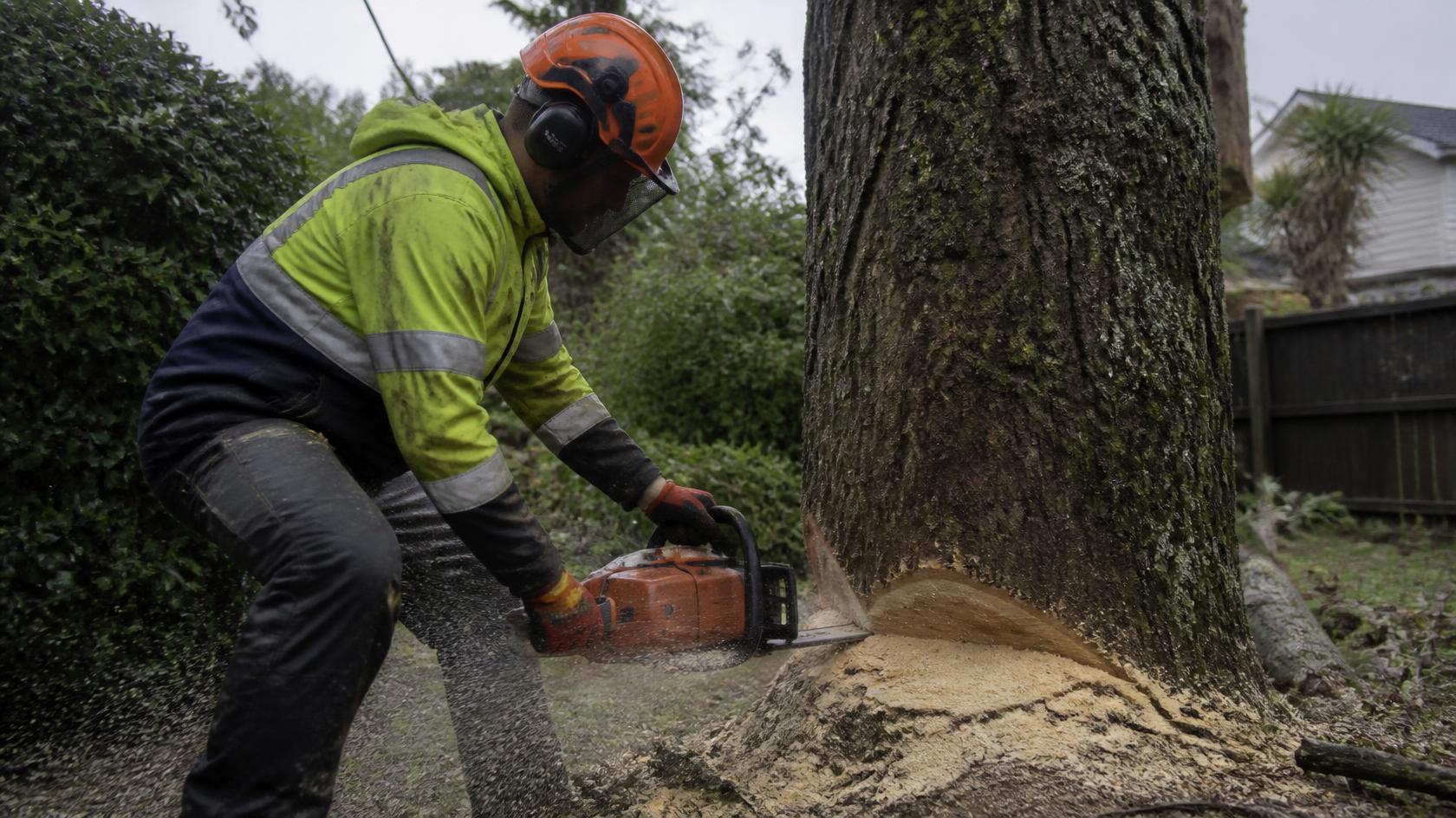
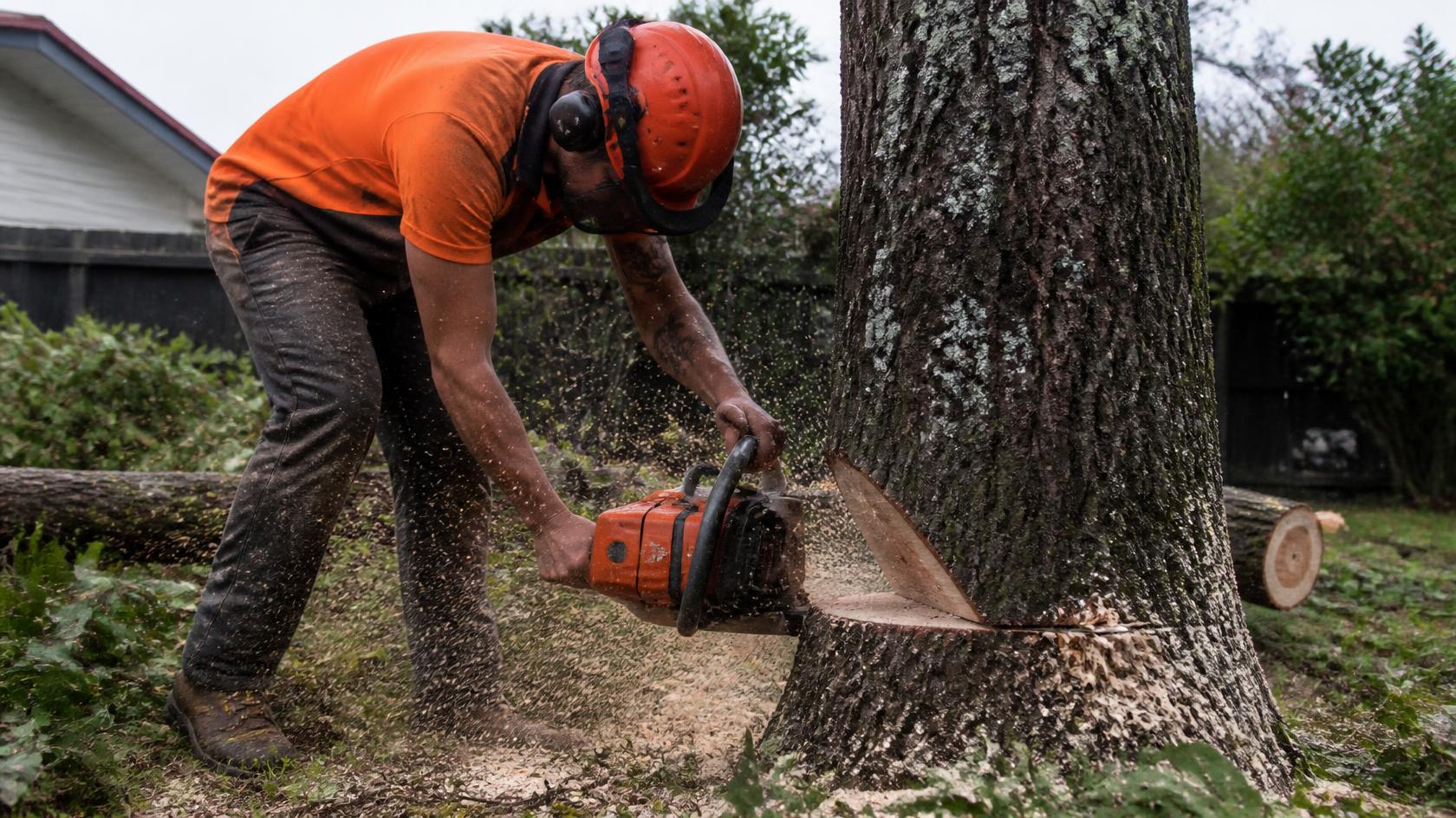
Felling looks simple from a distance and is anything but. The tree is brought down along a predetermined line using a scarf cut on the intended face and a back cut behind it, leaving a hinge of uncut wood that steers the tree as it goes over.
The hinge is the entire safety mechanism. Cut it through and the tree is free to go anywhere, including backwards. Getting the depth, height and taper of those cuts right — on a tree that may be leaning the wrong way, weighted to one side, or carrying internal decay you cannot see — is what the training is for.
Where a tree leans away from where it needs to fall, wedges or a winch line are used to drive it over against its natural lean. Where the lean is too severe or the wood too compromised to hold a hinge, we do not fell it. We dismantle it instead.
Suitability
When we will fell — and when we will not
This assessment happens on site, every time. Nobody should be agreeing to fell a tree from a photograph.
Good candidates
Open paddock or large rear sections, shelterbelt runs, lifestyle blocks, trees with an even crown and a natural lean toward clear ground, and sites where a truck and chipper can get alongside.
Not suitable
Anything where the drop zone contains a structure, boundary, road, watercourse or overhead line; trees with significant basal decay; severe or compromised leans; and hollow stems that will not hold a hinge.
Borderline — assessed carefully
Trees that need to be driven against a modest lean with wedges or a winch, and trees where the drop zone is adequate but tight. These are workable, but only after a proper look.
What we do instead
Sometimes the tree does not need to come down at all, and tree pruning solves the problem. If it does need to go and felling is not on, the tree comes out by sectional dismantling, or with rigging and crane assistance for the large and awkward ones.
Cost
Why felling saves you money
A sectional removal is dozens of separate operations: ascend, position, cut, rig, lower, reset. A fell is one. The saving is in labour hours, not in corners cut.
Material handling stays the same either way — a felled tree still has to be limbed, cut up, chipped and carted — so the saving is on the removal itself rather than the whole job.
If your section has genuine clear space, say so when you get in touch. It is the single most useful thing you can tell us.
Two other questions come up at this point. Arborists rarely price a fell by the hour: it is quoted per job, because the drop zone, the crew and the disposal decide the cost. And season makes less difference than access, though late summer's dry ground suits machinery best; see the best time of year to remove a tree.
| Tree size | Felled (clear space, incl. GST) | Dismantled (no space, incl. GST) |
|---|---|---|
| Small, to 6m | $250 – $600 | $400 – $900 |
| Medium, 6–15m | $500 – $1,100 | $900 – $1,800 |
| Large, 15–25m | $900 – $2,400 | $1,800 – $4,500 |
| Shelterbelt, per run | Quoted per length — substantially cheaper per tree | |
Indicative NZD ranges, incl. GST, including limbing, processing and clean-up. Stump grinding quoted separately (see what stump grinding costs). See the full Auckland cost guide.
Safety & standards
How felling is meant to be done
Tree felling is one of the most dangerous activities in New Zealand workplaces. The failure modes are well documented and consistently the same: barber-chairing on a leaning stem, the butt kicking back over the stump, a hung-up tree released without control, and struck-by injuries from limbs shed on the way down.
Every one of those is a planning failure rather than bad luck. Before a saw starts, the crew agrees the fall line, clears two escape routes at roughly 45 degrees behind the tree, checks the crown for hanging deadwood, and confirms nobody is inside the fall zone or the zone behind it.
WorkSafe New Zealand publishes guidance specifically on tree work and tree felling, including operational guidance on driving one tree onto another. If you are considering doing this yourself, read it first — it is sobering.
Think your section might have room?
Tell us the address and we will come and look. If felling works, you will get a noticeably better price than a sectional quote.
Related services
Often booked alongside
Section & Site Clearing
Felling several trees or a whole shelterbelt run is priced as a project, and works out far cheaper per tree.
Site clearingStump Grinding
A felled tree still leaves a stump. Grinding it while the crew is on site avoids a second mobilisation.
Stump grindingTree Removal
If the drop zone is not there, sectional dismantling is the answer. Same outcome, different method.
Tree removalWhere we work
Tree felling across Auckland
Felling is most often possible in the outer and southern suburbs, where sections stay open.
Questions
Tree felling FAQs
What is the difference between tree felling and tree removal?
Felling means cutting a tree at the base so it falls in one controlled piece. Removal is the broader job, and on most urban sites it means sectional dismantling — climbing the tree and taking it down in pieces. Felling is faster and cheaper but needs a clear drop zone at least as long as the tree is tall, which many Auckland sections simply do not have.
How much clear space do you need to fell a tree?
As a working rule, a clear area roughly one and a half times the height of the tree in the intended direction of fall, plus room for the crew to retreat. That space must be free of buildings, fences, power lines, vehicles and anything else that matters. We assess this on site rather than from a photo.
Is felling cheaper than sectional removal?
Usually yes, and often substantially. Felling is one controlled operation; dismantling the same tree means climbing, rigging and lowering dozens of separate pieces. Where a section genuinely allows felling — common in Massey, Pukekohe, Papakura and on lifestyle blocks — removals price noticeably better.
Can you fell a tree in a suburban back yard?
Sometimes, on larger or more open sections. On most suburban Auckland sites the drop zone is not there, and attempting to fell anyway is how fences, glasshouses and roofs get destroyed. If your site does not suit felling we will tell you and quote sectional removal instead.
Do I need permission to fell a tree on my own land in NZ?
Not usually for an ordinary garden tree on private urban land in Auckland, but check first. Scheduled notable trees, trees in a Significant Ecological Area, trees close to the coast or a stream, and trees kept as a condition of a consent all need resource consent. Felling also has its own risk: a tree that lands on a neighbour's fence or a line is your liability, whatever the rules say.
How much does it cost to cut down a tree in NZ?
Where there is room to fell it, cutting a tree down is usually the cheapest way to remove it, because it is one controlled operation rather than dozens of rigged lowers. In Auckland a felled small tree is roughly $250 to $600 and a large one $900 to $2,400 incl. GST, including clean-up. The stump is extra. The full size-by-size breakdown is in our cost guide.