Complex & high-risk removals
Large & Dangerous Tree Removal
Trees too big, too decayed or too close to something valuable for a conventional approach. Rigging, crane assistance and a proper plan before anyone leaves the ground.
- No drop zone needed
- Crane-assisted where it suits
- Honest assessment, free
Definition
What makes a removal ‘dangerous’
It is rarely just size. Most jobs in this category involve two or three of these factors stacked on top of each other, and it is the combination that dictates the method.
Structural failure
Decay in the trunk or root plate, a cavity, vertical cracks, or a union that has already partly split. The tree cannot be trusted to hold a climber or a hinge.
No drop zone
Buildings, boundaries, pools, glasshouses, retaining walls or a road within the fall radius. Every piece has to be controlled on the way down.
Live power lines
Conductors within the working area. Only network-approved crews work within the approach distances, and the line must be de-energised or covered by the network operator first. See trees near power lines.
Dead standing timber
Dead wood does not hinge and limbs fail without warning under load. These are usually worked from a platform or crane rather than climbed at all.
Steep or unstable ground
Common in Titirangi, Birkenhead and Mt Eden. Material has to be stopped rather than allowed to run downhill.
Already partly failed
Hung-up, leaning or partly uprooted trees (windthrow that has not gone all the way over) hold stored energy that will release somewhere. These are emergency work.
Method
Three ways a difficult tree comes down
Rigged sectional dismantling
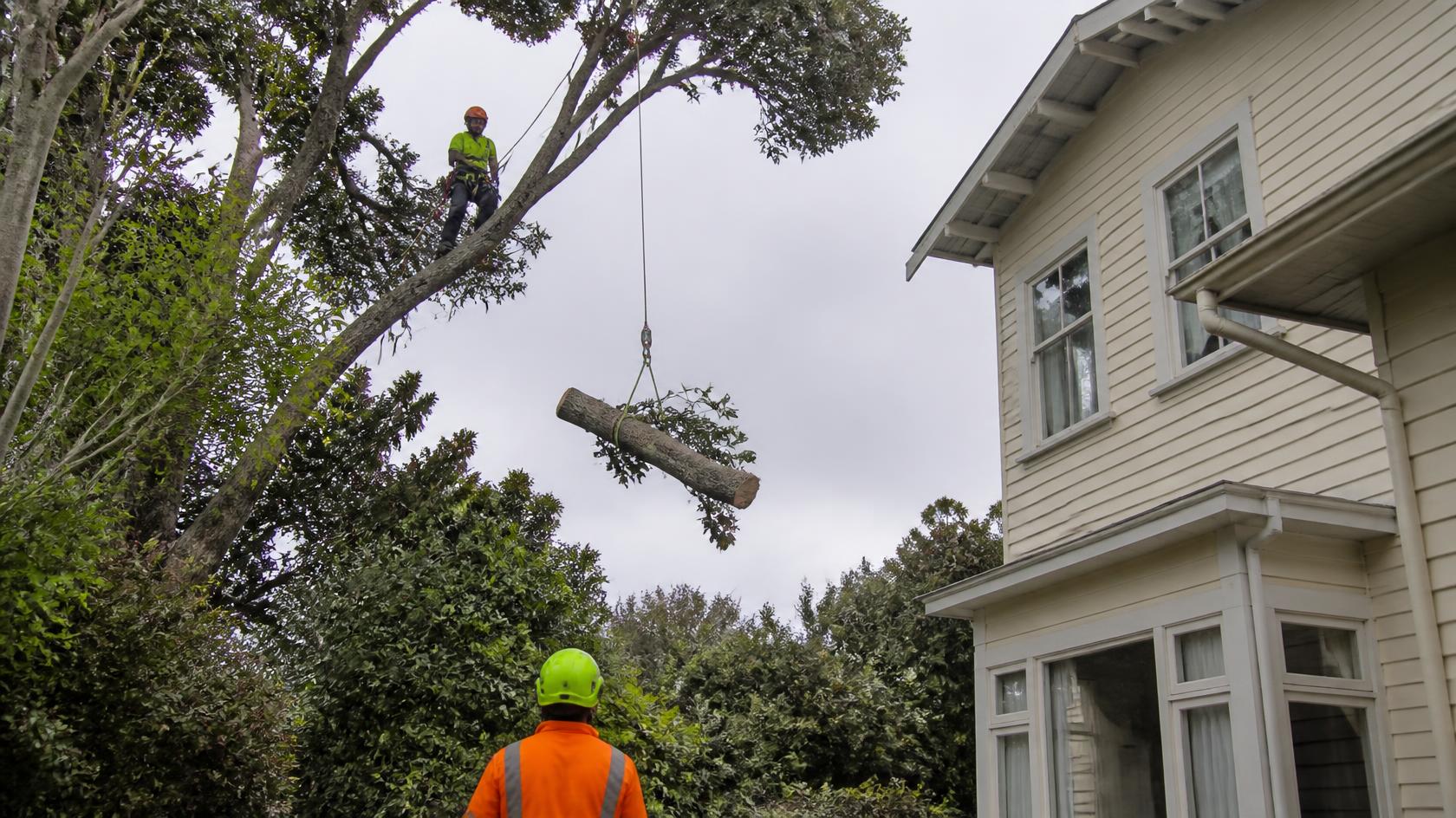
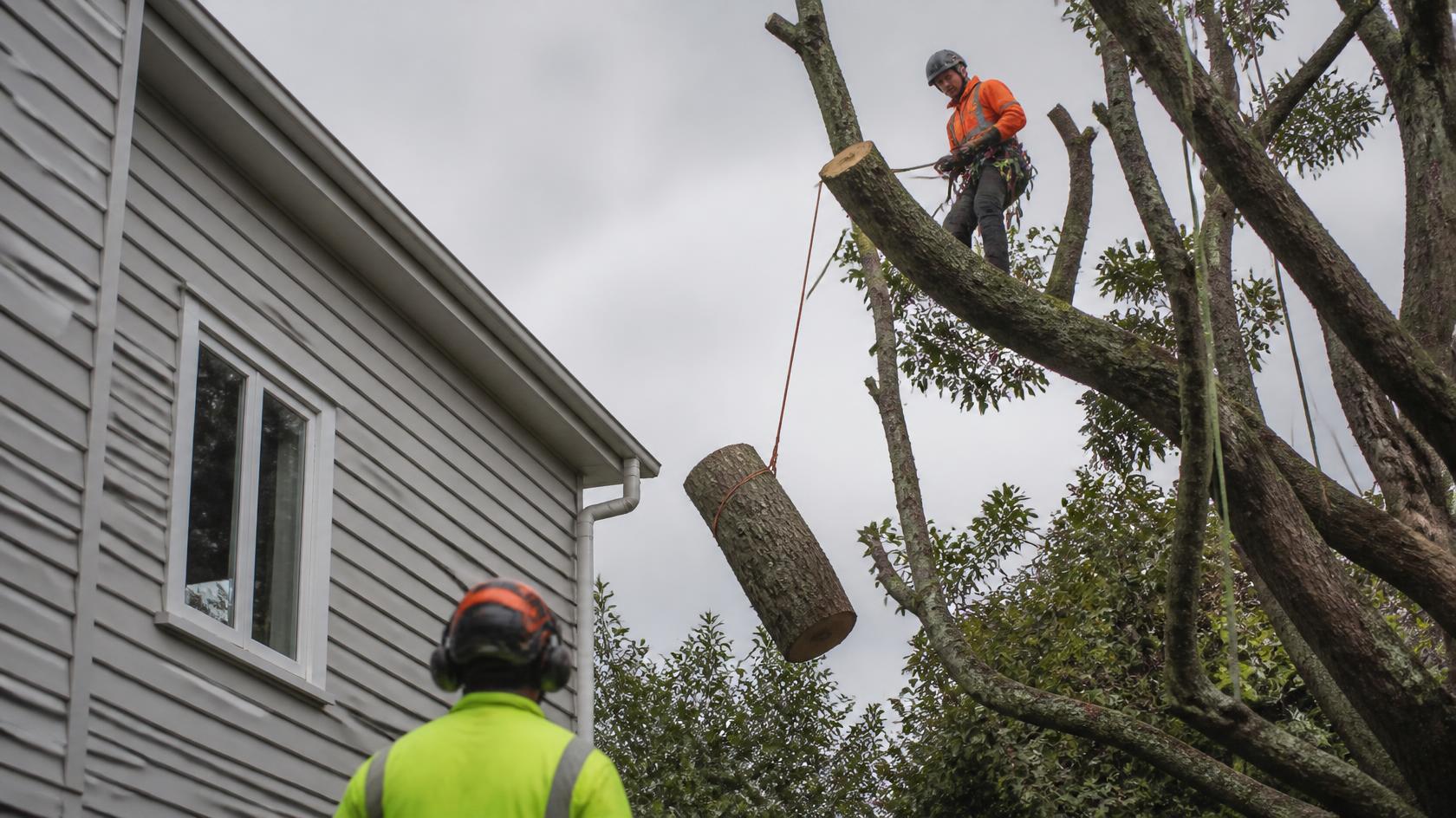
The standard approach. A climber works down from the top, tying each significant piece off before cutting so it is lowered under friction rather than dropped. Sections are sized to what the rigging point and the ground crew can safely take, which on a compromised tree means smaller pieces and more of them.
Crane-assisted removal
Where the site suits it, a crane takes the weight of a section before it is cut and lifts it clear in one movement. On a confined site with a valuable garden underneath, this is often dramatically less disruptive than a long sequence of rigged lowers — the material never touches the ground inside the property at all.
Elevated work platform
For dead or badly decayed trees that cannot safely be climbed, the arborist works from a platform beside the tree instead of from within it. Slower, and dependent on the ground taking the machine, but it removes the climber from the structure entirely.
Assessment
Not every alarming tree needs removing
This is worth saying plainly, because it costs us work: a large tree that looks frightening is often structurally fine, and a modest-looking one can be seriously compromised. Size and drama are poor indicators.
What matters is the relationship between the defect, the load the tree carries, and what would be hit if it failed. A hollow trunk with a thick, sound outer wall can be perfectly stable — trees are engineered as tubes. A small crack in the wrong union on a heavily end-weighted limb over a driveway is a genuine problem.
Sometimes the right answer is not removal at all. Taking out deadwood, reducing an over-extended limb, or removing the target underneath the tree can resolve the risk while keeping the tree. If that is the case with yours, we will say so.
What we look at
- Root plate: lifting soil, severed roots from recent earthworks, fungal brackets at the buttress.
- Trunk: cavities, vertical cracks, bulges, bleeding, and the thickness of sound wood around any hollow.
- Unions: included bark, previous partial failures, and end weight on major limbs.
- Crown: deadwood volume, dieback pattern, and asymmetry from wind or previous loss.
- Targets: what is actually underneath — a shed and a driveway are very different from a bedroom roof, a fence on a busy footpath or a parked car.
- History: recent construction, changed drainage, or a neighbouring tree removed that used to provide shelter.
Cost
What complex removals cost
| Scenario | Indicative cost (NZD, incl. GST) | Typical method |
|---|---|---|
| Large tree, good access, clear ground below | $1,500 – $2,800 | Rigged sectional |
| Large tree hard against a house or boundary | $2,500 – $4,500 | Small-section rigging, ground protection |
| Dead or badly decayed large tree | $3,000 – $6,500 | Platform or crane, not climbed |
| Crane-assisted removal | $4,000 – $10,000+ | Crane hire, traffic management, rigging crew |
| Tree requiring line de-energising | Add $500 – $1,500 | Network operator shutdown or line cover |
| Traffic management plan | Add $600 – $2,000 | Where a live lane or footpath is occupied |
Indicative NZD ranges, incl. GST. Crane hire, traffic management and network shutdowns are third-party costs that we itemise separately rather than burying in a single figure. Read the full breakdown of large tree removal cost in Auckland, including the very large and hazardous band.
Compliance
Protected trees are often the large ones
There is an awkward overlap here: the trees most likely to need specialist removal are also the trees most likely to be protected. Scheduled notable trees are scheduled precisely because they are large, old and significant, and big coastal pōhutukawa are the species most often on the list.
If a large tree on your property is genuinely hazardous but also protected, there are provisions for urgent works — but they are not a blank cheque. Auckland Council allows removal without consent only where the tree has fallen on a house, has just fallen or split, or may cause an injury. For a protected tree you then need written advice from a professional arborist on why it was urgent and what condition it was in, with photographs, and those go to the council within seven days. Your insurer will usually want the same record. Doing it the other way round, and dealing with the paperwork afterwards, is how people end up in enforcement proceedings.
We check the property's scheduling and overlays before quoting any established tree, and will tell you what the consent path looks like if one applies.
Check before you commit
- Auckland Council GeoMaps — scheduled trees and overlays by address
- Working on or around protected trees
- When a tree is dangerous and needs urgent removal
- Applying for resource consent for tree work
Worried about a big tree?
The assessment is free and we will give you a straight answer, including if the answer is that it can safely stay.
Where we work
Complex removals across Auckland
Questions
Large & dangerous tree removal FAQs
What makes a tree removal 'dangerous'?
Usually one of five things: the tree is structurally compromised by decay, cracks or previous failure; there is no safe drop zone because of buildings, boundaries or services; the tree is close to live power lines; the site is steep or unstable; or the tree is already partly failed, leaning or hung up. Most large-tree jobs involve more than one of these together.
How do you remove a large tree with no space around it?
By sectional dismantling. A climber works from the top down, cutting pieces small enough to control and rigging the heavier sections so they are lowered under tension rather than dropped. On very tight or high-value sites a crane can lift whole sections clear in one movement, which is often less disruptive than a long sequence of rigged lowers.
Do you use a crane?
Where the site suits it and there is somewhere legal and stable to set up. Crane-assisted removal is not automatically cheaper, but on confined sites with valuable gardens, pools or structures underneath it is frequently faster and gentler on the property. We will tell you if your tree is a good candidate.
Is a dead tree more dangerous to remove than a live one?
Considerably, yes. Dead wood is unpredictable — it does not hinge the way live timber does, limbs can fail without warning under a climber's weight, and decay is usually more advanced internally than it looks from outside. Dead trees are often removed using aerial platforms or cranes rather than being climbed at all.
Can you assess whether my large tree actually needs removing?
Yes, and we will tell you honestly if it does not. Plenty of large trees that look alarming are structurally sound, and some problems can be resolved by removing deadwood or reducing an end-weighted limb rather than taking the whole tree out. The assessment is free.