Turn a leaf over. A pōhutukawa leaf has a thick coat of fine white hairs underneath; rātā leaves don’t. That one check settles most arguments in an Auckland garden. This guide covers the other differences too: how each tree grows, where it grows, and how to rule out the two lookalikes people confuse with them, bottlebrush and the small “dwarf pōhutukawa” sold in garden centres. It also explains why the name matters less than you might think once removal comes up.
On this page
- How do you tell rātā from pōhutukawa?
- Pōhutukawa leaves: what to look for
- Are pōhutukawa native to New Zealand?
- Bottlebrush vs pōhutukawa
- Mini and dwarf pōhutukawa
- Pōhutukawa branches: weight, cracks and fallen limbs
- Is it illegal to cut down native trees in NZ?
- Pōhutukawa removal in Beachlands and the Pōhutukawa Coast
How do you tell rātā from pōhutukawa?
Check the underside of a mature leaf first. Mainland pōhutukawa (Metrosideros excelsa) is densely covered there in white hairs, and the Department of Conservation uses that as its quick test. Northern rātā (M. robusta) has rust-brown hairs on young leaves that mostly wear off, and a blunt, notched tip. Southern rātā (M. umbellata) is hairless and pale beneath, with a sharp point. Then look at the shape of the tree.
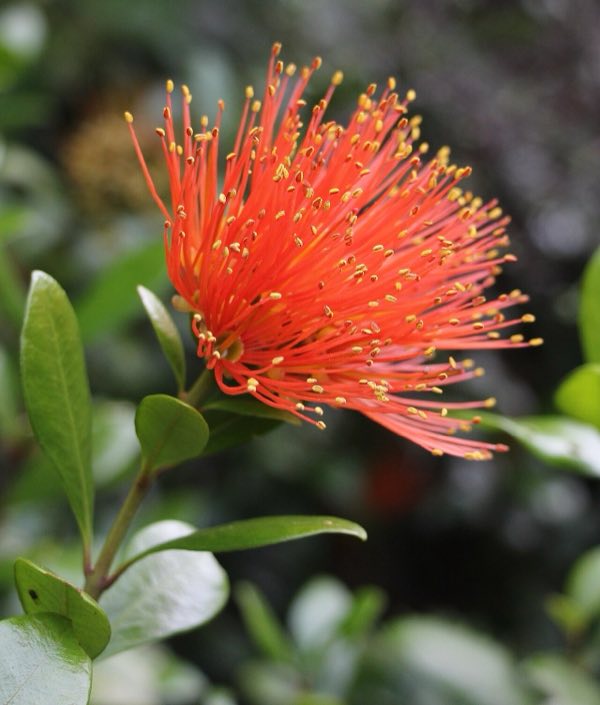
| Pōhutukawa | Northern rātā | Southern rātā | |
|---|---|---|---|
| Species | M. excelsa | M. robusta | M. umbellata |
| Leaf underside | Thick white hairs | Rust-brown hairs on young leaves, mostly shed with age; blunt, notched tip | Hairless and pale; sharply pointed tip |
| How it grows | Broad and spreading, often several trunks, up to about 20 m; aerial roots | Often starts life perched on a host tree; up to 40 m | Grows from seed in the ground; usually 15 m or more |
| Natural range | Upper North Island, north of about New Plymouth and Gisborne | North Island, and the South Island to about Westport | The most widespread rātā, from Northland to the Auckland Islands |
| Typical flowering | Mid to late December | About November to January | Summer, varying with altitude and latitude |
Leaf, habit and range from the Department of Conservation’s pōhutukawa and rātā pages and the NZ Plant Conservation Network. Flowering from NZ Flora (northern rātā) and Auckland tourism notes (pōhutukawa); individual trees and seasons vary.
Form is the second clue. In Auckland, a big, low, spreading tree on a bank or beachfront, with several trunks and curtains of roots hanging from its limbs, is almost always pōhutukawa. Northern rātā is a forest tree: it usually starts as a seedling high on another tree, sends roots down the host’s trunk and ends up tall and upright. You will see it in the Waitākere and Hunua Ranges far more often than in a suburban back yard.
Why some trees sit in between
Pōhutukawa and northern rātā cross where their ranges meet, and the NZ Plant Conservation Network notes that many plants sold as northern rātā are actually hybrids with pōhutukawa. A garden tree that has some white hair under the leaves, but less than you expect, may be one of these. For a planting choice that hardly matters. If you are reporting myrtle rust, say what you think it is and add a photo of both leaf surfaces.
Pōhutukawa leaves: what to look for
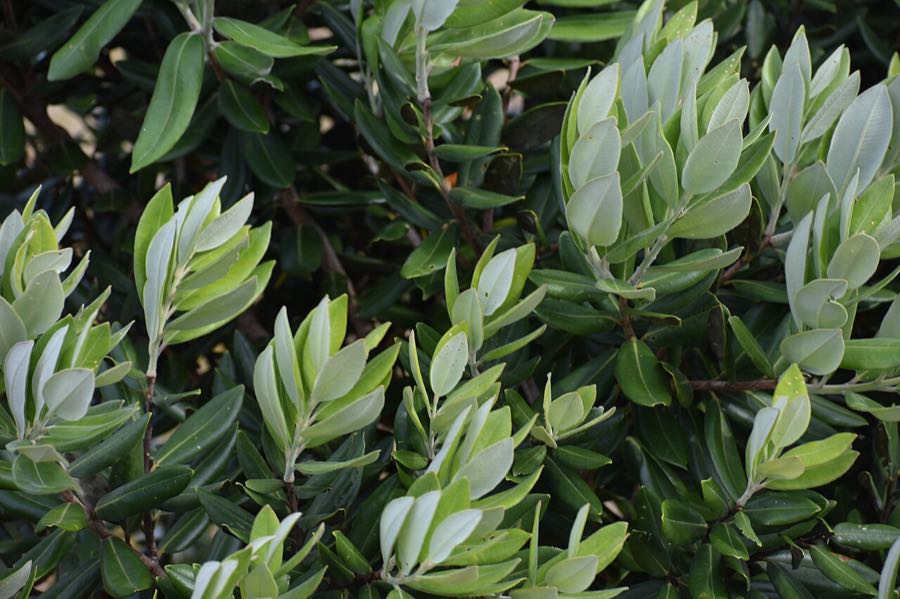
Mature pōhutukawa leaves are thick, leathery and oval, glossy dark green on top and felted white underneath. New growth is often covered in the same pale felt, which makes a young shoot look silvery. The leaves sit opposite each other on the stem. If a leaf is narrow and strap-like, smells of eucalyptus when you crush it, or is hairless and shiny on both sides, you are probably looking at something else.
Yellow, spotted or falling leaves
- A steady drop of old leaves through the year is normal for an evergreen. It is heaviest around flowering, when spent stamens come down too.
- Bright yellow, powdery spots on soft new leaves can be myrtle rust. Don’t cut or move anything; photograph it and report it, as our pōhutukawa care guide explains.
- Chewed shoots and a thinning crown usually mean possums.
- Whole branches browning off after building work or trenching point to root damage. That is worth an arborist’s look before it spreads.
Are pōhutukawa native to New Zealand?
Yes. Mainland pōhutukawa is endemic: it grows naturally nowhere else. Its natural range is the upper North Island, roughly north of New Plymouth and Gisborne. Trees in Wellington, Nelson or Christchurch were planted. The only other pōhutukawa, M. kermadecensis, is native to the Kermadec Islands, which are also New Zealand territory. Both are part of the myrtle family, Myrtaceae.
Outside New Zealand the story flips. Pōhutukawa was taken overseas as an ornamental and has gone wild in several places. The South African National Biodiversity Institute (SANBI) lists it as an invasive alien plant: it was introduced in the 1940s and is now spreading into wet fynbos on the Cape coast. A tree that councils here protect is cut out as a weed there.
Bottlebrush vs pōhutukawa: how to tell them apart
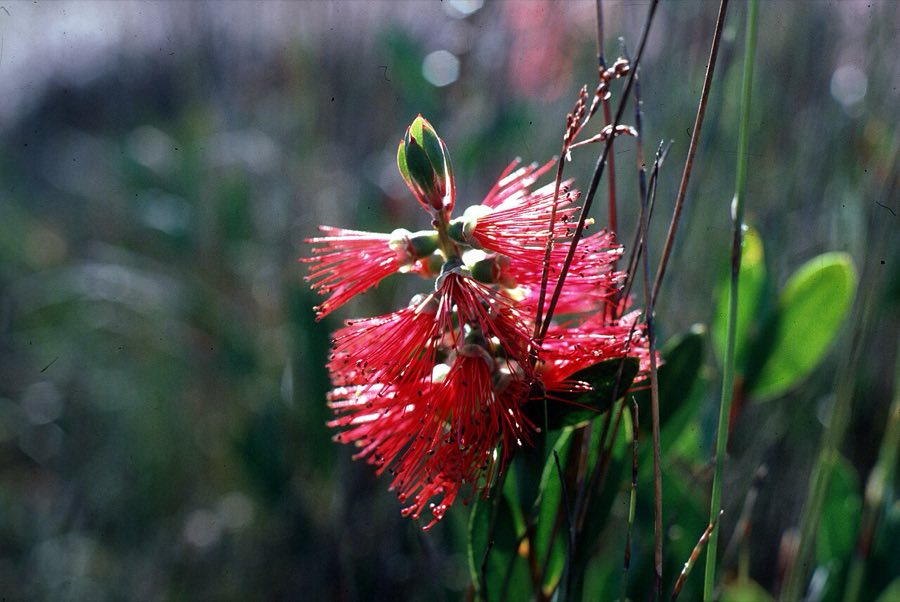
Look at how the flowers sit. Bottlebrush (Callistemon, now often grouped under Melaleuca) is Australian, and its red stamens are arranged all the way around a stem in a cylinder, like a brush for cleaning bottles. The shoot then keeps growing out past the flowers. Pōhutukawa carries its flowers in rounded clusters at the ends of the branches. Bottlebrush leaves are narrow and pointed, with no white felt underneath.
| Pōhutukawa | Bottlebrush | |
|---|---|---|
| Where it comes from | Endemic to New Zealand | Australia |
| Flowers | Rounded clusters at branch tips | Cylindrical spikes wrapped round the stem, with leafy shoot beyond |
| Leaves | Thick, oval, white felt beneath | Narrow, pointed, no felt |
| After flowering | Small capsules at the tips that open within months | Woody seed capsules that stay stuck along the stem for years |
| Usual size in a garden | Large tree, up to about 20 m with a wide spread | Shrub or small tree |
The two are relatives, both in the myrtle family, so bottlebrush can carry myrtle rust as well. And because it is not native, a garden bottlebrush is not caught by the coastal and stream rules that protect native vegetation near the water. A notable-tree listing or a consent condition would still apply to it like any other tree.
Mini and dwarf pōhutukawa: what you are actually buying
The small “dwarf pōhutukawa” in garden centres is usually the cultivar ‘Tahiti’. Nurseries list it at about 1 to 1.5 m tall and wide when mature, with orange-red flowers. Landcare Research’s NZ Myrtaceae key places ‘Tahiti’ under Metrosideros collina, a species from French Polynesia and the Cook Islands, so it is a Pacific cousin rather than a New Zealand native.
Labels vary. The same plant is sold as M. collina ‘Tahiti’, as a dwarf M. excelsa, and under misspelt names, so read the tag and expect a compact, rounded shrub rather than a scaled-down coastal tree. That matters if you want a small red-flowering plant by a path or in a pot: choose a dwarf from the start. A full-size pōhutukawa can’t be pruned down to that size without ruining it.
Pōhutukawa branches: weight, cracks and fallen limbs
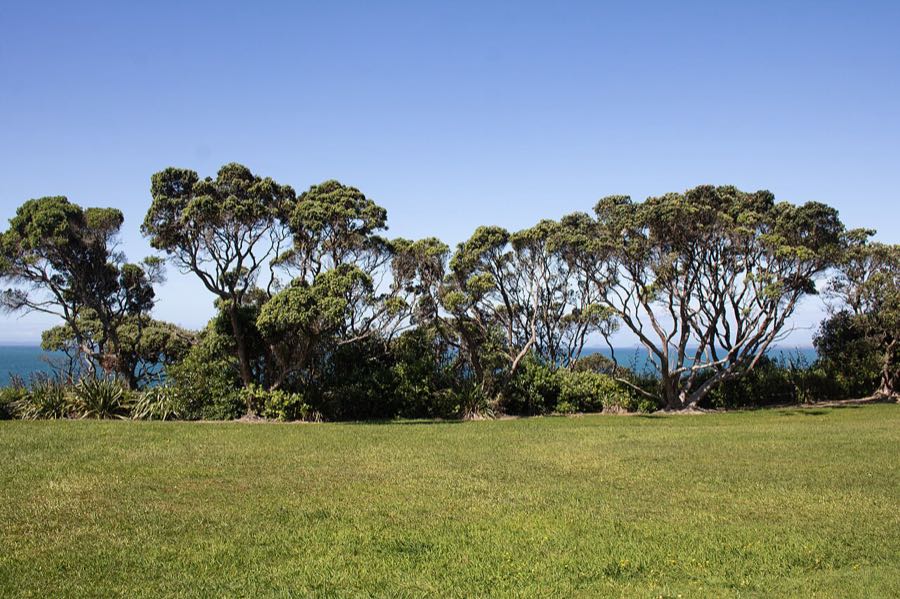
Pōhutukawa grow long, heavy limbs that reach out sideways, often far past the trunk and close to the ground. That spreading habit is the tree’s character, and most limbs are sound for decades. The ones that fail tend to have a reason: decay behind an old, badly made pruning cut, a split where two big stems meet, or a limb that has been loaded with a swing, a deck post or years of being leant on.
Signs a pōhutukawa limb needs looking at
- A crack or open seam along the top or bottom of the branch.
- Fungal brackets, soft wood or a cavity at an old cut.
- A limb that has dropped noticeably lower over a season, or now rests on a roof, fence or car.
- Dead wood high in the crown above a path or driveway.
If a branch has already come down, keep people clear of anything still hanging and photograph it before it is moved. On a street, park or beach tree, the tree belongs to Auckland Council: report it on 09 301 0101 rather than cutting it up yourself. On your own section, our storm-damaged tree guide covers the first steps, and a hanging limb over a house is a job for emergency tree work. The signs a tree is dangerous apply to pōhutukawa as much as any other tree.
A lawfully fallen branch from your own tree can be cut up and seasoned as firewood. If the leaves show yellow rust spots, leave it where it lies and report it first, because moving infected material spreads the spores.
Is it illegal to cut down native trees in NZ?
Not on species alone. Neither pōhutukawa nor rātā is protected everywhere just because it is native. In Auckland, what decides it is where the tree stands and whether it is listed: notable trees, coastal and stream setbacks, Significant Ecological Areas, and conditions on your title or an old consent. Outside those, a native tree on an ordinary urban section can come out like any other.
Pōhutukawa get caught far more often than most trees, because so many grow right on the coast. Our guide to pōhutukawa rules and consent sets out each limit and how to check your address, and the general guide to council consent for tree removal covers every other species.
Pōhutukawa removal in Beachlands and the Pōhutukawa Coast
The stretch from Whitford through Beachlands and Maraetai to Umupuia is called the Pōhutukawa Coast for its shoreline trees, and that is where removal questions get harder. A native tree over 3 m within 20 m of mean high water springs needs consent to remove or significantly alter in urban zones, and the setback is 50 m in most rural and coastal zones. Many waterfront sections there sit inside it.
Three things are worth checking before anyone quotes in Beachlands, Maraetai or the bays around them:
- Whose tree it is. A lot of the big beachfront pōhutukawa stand on esplanade reserve or road reserve, not private land, even when they look like part of the garden. Those are council trees, and only council can approve work on them.
- The distance to the water. Measure from the line of mean high water springs, not from your boundary. Auckland Council GeoMaps shows it alongside the overlays.
- Cliff tops. Within 20 m of the top of a cliff steeper than 1 in 3 near the sea, the same coastal rule applies, and cliff-edge trees are often holding the bank together.
If the tree is yours and clear of those limits, removing it is a normal job. If not, consent comes first, and it is usually easier to win approval for selective pruning or removing a single limb than for felling. We cover the eastern suburbs from Howick out to Beachlands and Whitford; ask for a free assessment and the tree business that comes out will tell you which rules apply before it prices anything.
General information for identifying pōhutukawa, rātā and their lookalikes, not advice about a specific tree. Confirm any protection with Auckland Council before work starts. See our disclaimer.
If this sounds like your tree, see Tree Removal Auckland for how we assess, quote and clean up.
Frequently asked questions
Is rātā the same as pōhutukawa?
No, but they are close relatives. Both belong to the genus Metrosideros in the myrtle family, both flower red in early summer, and pōhutukawa and northern rātā hybridise where they grow together. Pōhutukawa is the broad coastal tree with white felt under its leaves. Northern rātā is a tall forest tree that often starts life on another tree, and its mature leaves have no white felt.
Is a bottlebrush a native New Zealand tree?
No. Bottlebrush (Callistemon, now often included in Melaleuca) comes from Australia, although it is a common garden plant here. It is in the same family as pōhutukawa, which is why the red flowers look similar from a distance. Close up, a bottlebrush carries its stamens in a cylinder wrapped around the stem, has narrow pointed leaves, and keeps its woody seed capsules along the branch for years.
How big does a dwarf pōhutukawa get?
The usual dwarf, the cultivar 'Tahiti', is listed by nurseries at about 1 to 1.5 m tall and about as wide after several years, so it suits pots, borders and small courtyards. It is generally classed under Metrosideros collina, a Pacific Islands species, rather than New Zealand pōhutukawa. A full-size pōhutukawa can't be kept that small by pruning, so choose the dwarf from the start.
When do pōhutukawa flower in Auckland?
Mostly in December, peaking mid to late in the month, which is why pōhutukawa is called New Zealand's Christmas tree. Some trees start in November and a few carry on into January, depending on the tree and the season. Northern rātā flowers over a similar window, roughly November to January, so the timing alone won't tell you which tree you have.