24/7 storm & emergency response
Emergency Tree Removal Auckland
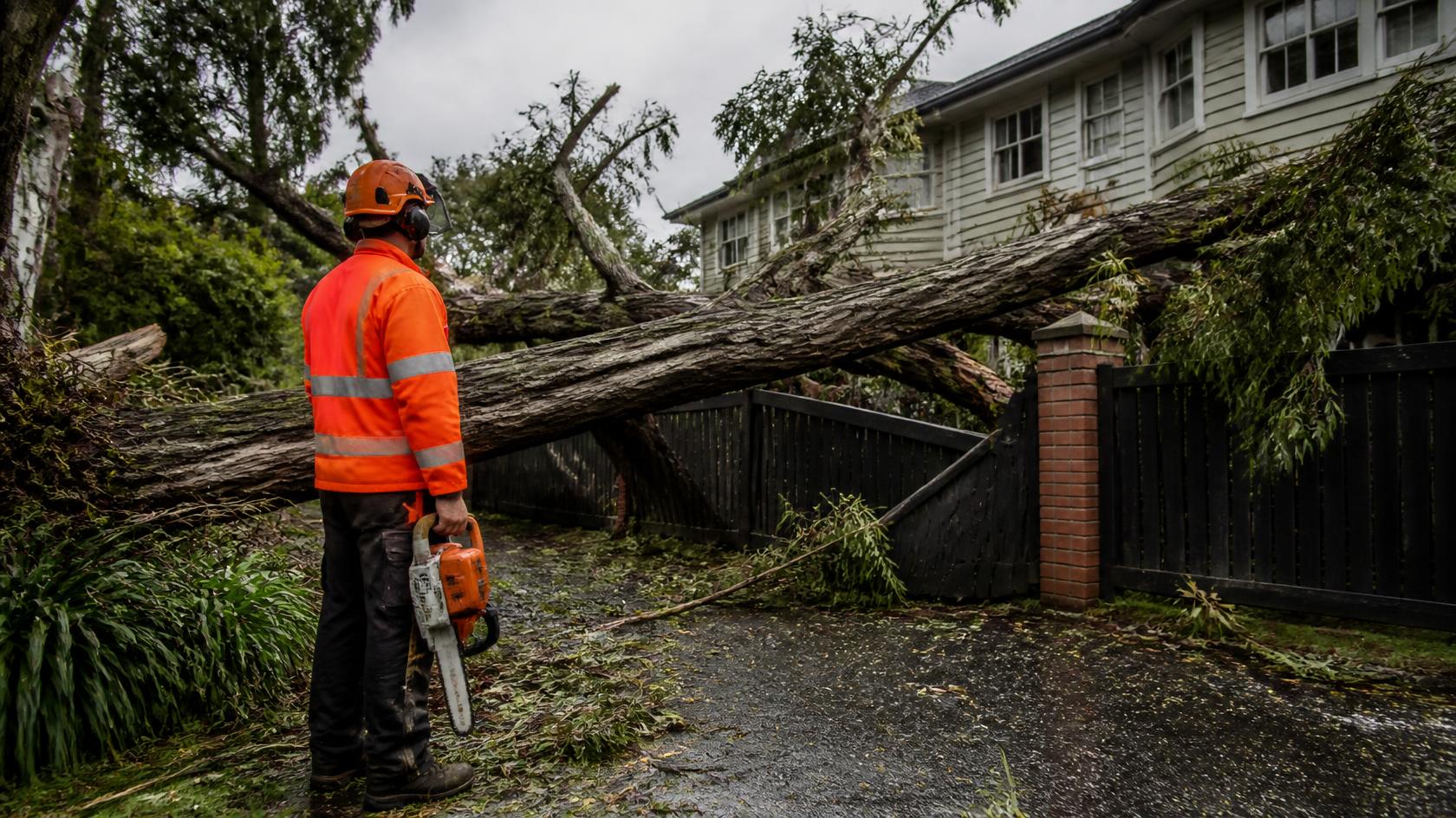
Tree on a house, across a driveway, hung up in another tree, or half out of the ground? Phone us — emergencies are triaged by risk, day or night.
- Call-outs outside normal hours
- Triaged by risk, not queue position
- Insurance documentation provided
Electricity arcs — you do not have to touch a line to be killed by it, and wet ground and green wood both conduct. Stay at least 10 metres back, keep everyone else back, and assume every line and every wet surface near it is live. No tree work can begin until the line has been de-energised or covered. WorkSafe NZ guidance on working near electricity.
First
What to do before we arrive
The first fifteen minutes matter more than most people realise. Storm-damaged trees are under load in ways that are not visible from the ground, and the commonest serious injuries happen to property owners trying to help.
Get people clear
Everyone out of the affected part of the building and away from the tree. Keep children and pets inside. A partly failed tree can move again without warning.
Check for power lines
If any line is involved, or you are not certain, stay 10 metres back and call the network operator or 111 before anything else.
Photograph from a distance
Wide shots and close-ups from safe ground. Your insurer will want these, and they are much harder to take once the tree is gone.
Call your insurer
Most policies cover removal where the tree damaged an insured structure. Get the claim number before authorising non-urgent work.
Phone us, do not email
Emergencies are triaged by risk. A phone call lets us assess severity properly and get you into the right slot.
Never attempt these yourself
- Anything touching a power line. No exceptions, no matter how minor it looks.
- A hung-up tree. One caught in another tree or on a structure holds enormous stored energy and can release in any direction.
- A partly uprooted tree. A lifted root plate can slam back down or the stem can roll when tension is released.
- Cutting anything under tension. Bent and compressed wood springs violently when cut — this is the leading cause of serious chainsaw injury in storm work.
- Working from a ladder with a chainsaw. There is no safe way to do this.
What we handle
Emergency call-outs we respond to
Tree on a building
Made safe, sectioned and lifted off in a sequence that does not add to the damage. Documented for your insurer as we go.
Blocking access
Trees across driveways, right-of-ways and rural tracks, cleared enough to restore access first and tidied properly afterwards.
Hung-up trees
Brought down under control with winches and rigging rather than by cutting and hoping. Among the most dangerous situations in this trade.
Partial windthrow
Trees that have lifted but not gone over. Assessed for stability, then either taken down or made safe depending on what the root plate is doing.
Storm-shed limbs
Large limbs hung in the canopy or resting on a roof, removed before the next blow brings them the rest of the way.
Trees on vehicles & fences
Lifted clear with the damage documented first, so your claim is straightforward.
Response
How we triage after a storm
When a serious front goes through Auckland, we take more calls in a day than in a normal fortnight. We cannot get to everyone at once, so we work by severity rather than by who rang first.
Priority one is anything with a life-safety component: trees on occupied buildings, trees involving power lines, and trees blocking the sole access to a property where someone may need to get out.
Priority two is active property damage — trees on garages, vehicles, fences and outbuildings, and unstable trees threatening to cause further damage imminently.
Priority three is everything else: fallen trees that damaged nothing, blocked back gardens, and general storm tidy-up. These are booked into the following days.
If your situation changes — the tree moves, or something becomes unsafe — ring back and tell us. We will re-triage.
Insurance
How storm tree claims usually work
Most New Zealand home policies cover the removal of a fallen tree as part of repairing the damage it caused to an insured structure — a house, garage, fence or vehicle. What is much less commonly covered is removing a tree that fell and damaged nothing, or removing a live tree you have simply decided you want gone.
Because of that split, sequence matters. Photograph everything before work starts, get a claim number, and keep our written documentation. We can provide a description of the work and the condition we found things in, which is usually what an assessor asks for.
Where a neighbour's tree has come down on your property, liability generally turns on whether the tree's owner knew or reasonably should have known it was hazardous. A healthy tree brought down by an exceptional storm is usually treated as an act of nature. This is exactly why raising concerns about a neighbour's tree in writing is worth doing.
Prevention
Most storm damage is predictable
After every big blow we remove trees that had been showing warning signs for months. Deadwood, decay at the base, cracks in a major union — these do not appear overnight.
Get deadwood out before winter
Dead limbs in a crown are the first thing to come down in wind, and they are cheap to remove while the tree is standing.
Know the warning signs
Fungal brackets, a new lean, lifting soil and vertical trunk cracks all point to failure ahead. The nine signs, explained.
Watch the wet season
Saturated ground holds a root plate far less securely. Most windthrow happens in wet-weather wind, not the strongest dry gusts.
Tree down right now?
Phone rather than emailing. Emergency call-outs run outside normal hours, seven days, right across the Auckland region.
Where we work
Emergency response across Auckland
Questions
Emergency tree removal FAQs
What counts as an emergency tree removal?
A tree or limb that has fallen on a building, vehicle, driveway or fence; a tree blocking the only access to a property; a tree hung up in another tree or on a structure; a tree that has partly uprooted and is visibly unstable; or any tree in contact with a power line. If people or property are at immediate risk, treat it as an emergency and phone rather than email.
How quickly can you get there?
Genuine emergencies are prioritised and we run call-outs outside normal hours, seven days. After a widespread storm, demand across Auckland spikes and we triage by risk — trees on houses, trees blocking sole access and anything involving power lines go first. Phoning gets a faster response than an online form.
What should I do before you arrive?
Keep everyone well away from the tree and from anything it is resting on, and keep pets and children indoors. If any power line is involved, stay at least 10 metres back, treat every line and wet surface as live, and call the network operator or emergency services first. Photograph the damage from a safe distance for your insurer. Do not attempt to cut anything under tension.
Does insurance cover emergency tree removal?
Usually where the tree has damaged an insured structure — most New Zealand home policies cover removal as part of repairing damage to a house, garage, fence or vehicle. Cover for removing a fallen tree that damaged nothing is far less common. Ring your insurer as early as you safely can, and keep photographs and our written documentation.
Why can't I just cut it up myself?
Fallen and hung-up trees hold enormous stored energy in compressed and stretched wood. Cutting into that without understanding where the tension is causes the section to spring, roll or drop without warning, and it is a leading cause of serious chainsaw injury. Storm-damaged trees are the single worst situation for anyone without training to attempt.